How China's 'Little Giants' Are Quietly Dominating Global Niche Tech Supply Chains
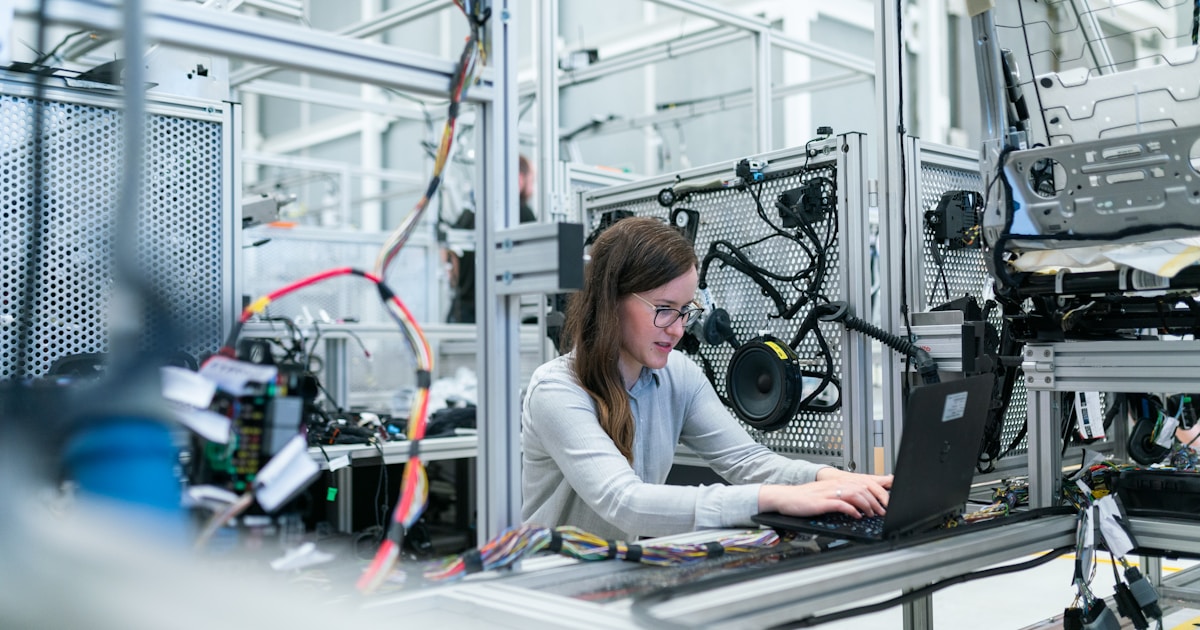
When people think of Chinese manufacturing, they picture Foxconn-scale factories assembling iPhones by the millions. But the real story of China's industrial future isn't happening in those mega-factories. It's happening inside 17,578 specialized small and medium enterprises—known as "Little Giants"—that are quietly dominating global supply chains one niche at a time.
What Exactly Is a "Little Giant"?
The term "Little Giant" (专精特新"小巨人") is a formal government designation for top-tier SMEs that excel in niche markets with strong innovation capabilities and core technologies. The full name translates to "specialized, refined, distinctive, and innovative"—and each word matters.
These aren't startups chasing the next big thing. The average Little Giant has been operating for 17.8 years, deeply focused on a single technology or product category. More than 66% have registered capital under 100 million yuan (about $14 million)—small by industrial standards, but with outsized market influence.
As of March 2026, China had certified 17,578 national-level Little Giants across seven batches. Over 80% concentrate in strategic emerging industries: new materials, high-end equipment, new energy, biopharmaceuticals, and integrated circuits. They account for just 3.5% of China's major industrial SMEs but contribute 9.6% of operating revenue and 13.7% of total profits.
"Little Giants are not about being big. They're about being indispensable. In their specific niches, the global supply chain literally cannot function without them." — Industry Analyst
Innovation: The Patent Arsenal
The innovation output of these companies is staggering. Collectively, Little Giants hold 1.679 million patents, of which 469,000 are invention patents—the highest-value category. That represents 5.92% of all invention patents granted in China, despite these companies representing a tiny fraction of total enterprises.
They've also participated in drafting 14,292 national standards and 23,853 group standards—meaning these small companies are literally writing the rules that entire industries follow.
Geographically, over 70% of Little Giants are concentrated in eastern China—the Yangtze River Delta and Pearl River Delta regions. Guangdong, Jiangsu, Zhejiang, and Shandong lead the pack, benefiting from dense supplier networks, talent pools, and logistics infrastructure.
Case Study: The Car Film Company That Went Global
Jiujiang Lida Technology Co., Ltd.
A few years ago, Wang Jun, VP of this Jiangxi-based automotive film company, couldn't secure a single deal at a North American trade fair. Today, the company exports $4 million worth of plastic car films annually—films as thin as paper that can withstand forceful pulling, block heat effectively, and resist sharp impact.
This is the Little Giant trajectory: years of quiet technical refinement, followed by sudden global market penetration when the product quality becomes undeniable.
Dolphin Star Intelligent Technology (海豚之星)
This Suzhou-based Little Giant specializes in industrial robots for narrow-aisle warehouse scenarios. By optimizing joint designs and adding AI vision sensors specifically for overseas factory environments, the company has built sales and service networks in over 20 countries. Overseas revenue now exceeds 40% of total revenue, with sales growing 3-4x.
AI Is Transforming the Little Giant Playbook
Since 2025, China's Ministry of Industry and Information Technology (MIIT) has rolled out targeted policies to accelerate AI adoption among Little Giants. The government released 238 AI application scenarios specifically for SMEs and published industry-specific transformation guides.
DeepSeek-R1 and other domestic large language models have become key enablers. Their open-source nature and low deployment costs make them accessible to smaller firms. For example, COSMOPlat, an industrial internet platform, integrated DeepSeek-R1 into its industrial AI model for injection molding optimization and intelligent flexible assembly—applications that directly benefit factory-floor SMEs.
But adoption isn't smooth. According to the China Academy of Information and Communications Technology (CAICT), while over half of surveyed SMEs have experimented with AI, only 23% have achieved core-business-scale AI deployment. The main barriers: insufficient strategic awareness, weak data foundations, and a shortage of specialized talent.
💡 The "Three Don'ts" Problem
CAICT identifies three barriers to AI adoption among Chinese SMEs: "Don't want to" (strategic uncertainty), "Don't dare to" (risk aversion), and "Don't know how to" (talent shortage). The market still lacks lightweight, precise, low-cost AI products tailored to SME needs. Solving this is the next frontier.
From "Going Out" to "Weaving a Global Net"
The globalization strategy of Little Giants has evolved significantly. It's no longer about simply exporting products—it's about capability export and ecosystem integration.
In 2025-2026, MIIT launched dedicated overseas service initiatives, organizing matchmaking events under the "Smart Chain Global" banner. The approach has shifted from individual companies "going it alone" to a "group出海" (collective overseas expansion) model.
One example: SINOVAlink, a cross-border platform, has assembled over a dozen national-level Little Giants into a "full industry chain overseas solution." Using an AI-powered export engine, the platform identifies overseas procurement needs, matches them with member companies' capabilities, and uses a GP (general partner) risk-sharing model to co-invest in project execution.
The Infrastructure Backing
China's digital infrastructure provides the backbone. By March 2026, national intelligent computing capacity reached 188 million PFLOPS (FP16), dramatically lowering computing costs for SMEs. The government is also accelerating international submarine and land cable expansion, building cross-border computing networks to support Little Giants' overseas operations.
Jiangsu Province's 2026 "Five New" initiative specifically targets wind power, smart equipment, and high-value-added exports, helping Little Giants penetrate Belt and Road and emerging markets. The model combines leading enterprises as anchors, overseas platforms as enablers, and government services as safety nets.
Why This Matters for Global Supply Chains
For decades, the narrative about Chinese manufacturing was simple: cheap labor, massive scale, copycat products. The Little Giant phenomenon rewrites that story entirely.
These companies are not competing on price. They compete on technical indispensability. In their specific niches—whether it's a specialized automotive film, a narrow-aisle warehouse robot, or a precision optical component—they are often the only supplier that meets the required specifications.
The implications for global supply chains are profound:
- Single points of dependency: Many Western manufacturers rely on Little Giants for critical components without knowing it
- Innovation from unexpected places: The next breakthrough in materials science, robotics, or biotech may come from a 50-person company in Suzhou
- A new competitive model: China is building depth, not just breadth—thousands of world-class specialists, not just a few giant generalists
The Challenges Ahead
Despite the momentum, Little Giants face real headwinds. Geopolitical tensions complicate international expansion. Talent competition with larger tech firms is intense. And the AI adoption gap—that 23% figure—suggests most haven't yet figured out how to integrate AI into their core operations.
There's also a structural question: can these companies maintain their focus as they scale? The "Little Giant" designation is designed to encourage depth over breadth, but the pressure to grow revenue can pull companies toward diversification rather than specialization.
Conclusion: The Hidden Backbone of China's Industrial Future
China's Little Giants represent a fundamentally different approach to industrial policy. Instead of picking national champions and pouring resources into a few giants, the strategy cultivates thousands of specialized champions—each dominant in a narrow but critical slice of the global supply chain.
For anyone trying to understand China's manufacturing evolution, the lesson is clear: don't just watch the headline-grabbing giants like BYD, Huawei, or DJI. Watch the 17,578 Little Giants beneath them. They are the ones filling the gaps in supply chains, writing the technical standards, and quietly becoming the companies that the world's factories cannot live without.
In an era of supply chain disruption and industrial policy competition, the country with the most Little Giants may have the most resilient industrial base of all.